Origins
Freemasonry is one of the oldest and largest fraternal organizations in the world. Its official recorded history places the founding of the Order in 1717 in London, England. Here, a number of like-minded and influential individuals joined together to form a governing body for the Craft. Since that time, lodges have been established around the world and many famous people and political figures have joined their ranks.
It can reasonably be argued that in order to unite groups, those groups must have already existed. There is ample evidence that the customs and practices of modern Freemasonry extend even further into history. Undeniably, the lore and practices of Masons are intimately linked to ancient legends and historic events. While that doesn’t necessary imply direct association, it does provide ample evidence for speculation on the origins of the Masonic art.
However, while many speculate that Freemasonry begun at the same time civilization took root, there is no real evidence for this claim. Freemasonry, as we know it today, likely came into being about 800 years ago. At that time the practice was strictly operative – meaning that members were skilled labourers engaged in building the many Gothic-era structures found across Western Europe. The word “mason” means “builder”. Many of these ancient buildings still exist today – a testament to their skill and ability.
At the height of this building boom, workers formed themselves into guilds (similar to today’s unions). The guilds formed a lodge at the various worksites. Each lodge was governed by a group of officers and members were recognized by the degree of their experience and ability. The levels of recognition governed the workers’ tasks, responsibilities and compensation.
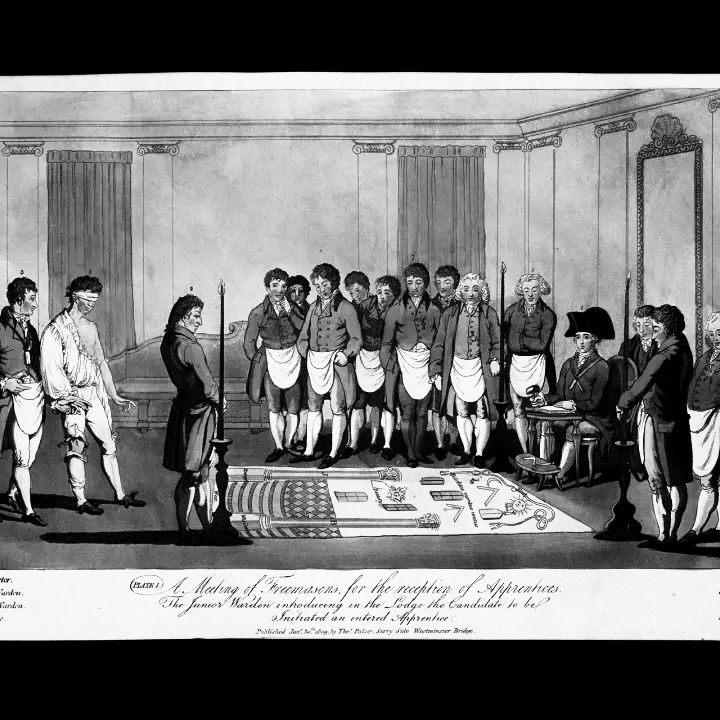
Each guild member was expected to prove himself proficient at his assigned work before being permitted to advance to a higher degree. Being accepted as an apprentice (the first level) was an honour and a very solemn commitment. An apprentice was taught the basic skills necessary to perform his duties. He was expected to dedicate himself to learning, improving his proficiency and to follow the guidance of his masters. His purpose was to work with others for the common good and for the attainment of the common goal. In those days, architecture and engineering was an art form.
Learning the secrets of math, geometry and science was not merely a matter of professional development – it was also considered a societal, spiritual and moral undertaking. Successful apprentices advanced to higher ranks as they proved themselves. Each level required additional proficiency, commitment and responsibility. For many, this notion of advancement by merit is the central pillar of the modern Masonic tradition.
Evolution
By the 1700’s, the building of monumental structures began to wane. Along with this trend, the power and influence of the ancient guilds began to fade. They began exploring ways to protect their independence. At the same time there was an intellectual renaissance taking place across Europe. It was a time of scientific, philosophical, artistic, political and spiritual exploration. It was also a period in which some of these ideas were considered radical and dangerous by the powers that be. Enlightened men sought ways to have open discourse in a protected environment without fear of persecution.
These two factors created the foundations of modern Freemasonry. The Guilds began to accepting members who were not practising, or operative, stonemasons. These men benefited the lodge through their political influence and their network of wealthy connections. They were drawn by the ancient customs and practices of brotherhood and equality as much as by the protective and secretive nature of the lodge. As these “gentlemen” members did not work with stone, they were recognized as “speculative masons” whose role was to advance the learning of fellow members. Within the lodge, open and free discussion was not only permitted but it was encouraged. Every member was expected to contribute to the learning and growth of his fellow members.
Today’s Masons
Over the past few centuries, Freemasonry has become almost entirely speculative. Members represent every social class and profession. The ancient traditions, however, remain as the cornerstones of Masonic activity. The rituals and traditions provide lessons for leading a good life and reinforcing the benefits of personal morality. The experience is personal and different for each individual. What binds them all together is the desire to learn with an open mind, the opportunity to enjoy friendly companionship and the ability to support and respect each other.
What’s the Big Secret?
The term FREEmason is often attributed to the theory that guild members were afforded special freedom to move about to where their skills were in demand. During much of this period of history, few people had such luxury. They were obliged to serve landowners, kings and the church in exchange for protection, food or a roof over their heads. Few people had the means to escape generations of family debt and servitude. Skilled masons, however, were in great demand. They had a valuable commodity, skilled labour, that could be traded for personal mobility.
At each construction site a lodge governed the work of these skilled labourers. The lodge had a dual role. On one hand it trained and protected members; on the other it was required to provide the highest quality of workmanship for their employers. The result was a standardization of skills and the implementation of a method of “identification”. In those days there was no such thing as government-issued ID or union cards. Few people, even highly-skilled tradesmen, could even read or write. Therefore secret codes, passwords and symbols were instituted to enable members to identify themselves to each other, even among strangers. Of course, these codes were considered to be of the utmost secrecy in order to protect their own livelihoods as well as the integrity of their fellow members.
This tradition of identification continues today among modern Freemasons. The “secret handshake” has long been identified as a Masonic practice. And, following these ancient traditions, Freemasons also incorporate other secret rituals that are passed along to members as they progress through the ranks of their craft.
© 2026 – Oakville Lodge № 400
 Oakville Lodge № 400